
BASALT documentation#
Genome-resolved metagenomics · PKU-EMBL Laboratory
Recover and refine metagenome-assembled genomes across one or more assemblies in a checkpointed workflow.
BASALT connects multi-binner candidate generation, within- and between-assembly bin selection, contig-level contamination screening, read-supported retrieval, and reassembly.
Get startedDiscover BASALT-AirPlan a studyExplore the method
Nature Communications 2024New: BASALT-Air v1.0.0Multi-assemblyMIT licensed
New implementation: BASALT-Air v1.0.0
BASALT-Air is now available for new deployments. It uses Pixi, accepts absolute input paths, separates working and output directories, and records a structured run manifest. Read Choosing BASALT-Air before switching: the executable, sample delimiters, path options, and checkpoints are not interchangeable with this Conda edition.
Evidence boundary
The published study reports improved MAG recovery and downstream genome-resolved analyses relative to the workflows and datasets tested. This is not a guarantee for every community or sequencing design. Dataset complexity, sequencing depth, assembly quality, read type, database choice, and parameter settings can change the outcome.
Core advantage: coherent multi-assembly refinement#
BASALT can jointly evaluate sample-specific assemblies and a biologically matched co-assembly. The former can preserve sample-restricted populations while avoiding some pooling complexity; the latter can increase effective depth for genomes shared across samples. In related longitudinal, spatial, technical, intervention, stage, or environmental-gradient designs, concordant cross-sample coverage changes provide an abundance fingerprint that complements tetranucleotide composition and sequence overlap during candidate selection, dereplication, contig screening, retrieval, and reassembly.
This strategy is most informative when samples share substantial genomic content while retaining biologically meaningful abundance variation. It does not justify pooling unrelated samples or guarantee better MAGs. Use a prespecified pilot to compare individual-only, pooled-only, and combined designs under identical quality criteria. See Study design patterns for supported layouts and decision boundaries.
Start here#
Choose the route that matches the decision you need to make. Commands and defaults on this site are checked against the current repository.
Configure BASALT, model weights, quality-control databases, external executables, and containers.
Launch an isolated short-read run with explicit resources, mode, and output name.
Choose between sample-specific, pooled, longitudinal, and multi-assembly strategies.
Follow each executable stage and distinguish software behaviour from interpretation.
Locate final MAGs, inspect quality reports, and diagnose incomplete stages.
Archive provenance and use the minimum Methods and reporting checklist.
BASALT framework#
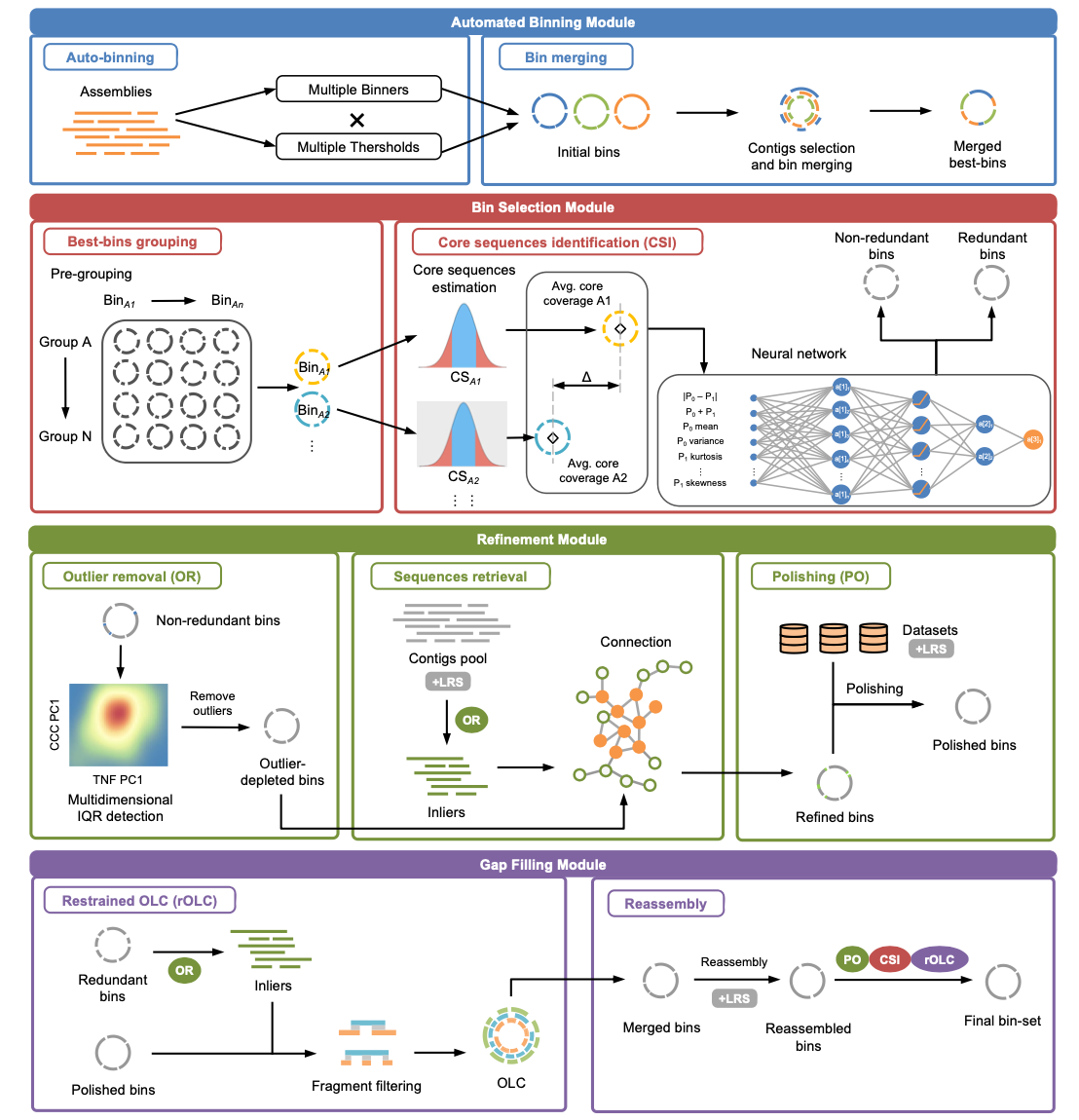
The BASALT framework integrates multi-binner candidate generation, within- and cross-assembly selection, model-based contig screening, read-supported retrieval, polishing, and reassembly. See Pipeline and methods for stage-level behaviour and interpretation boundaries.#
Method at a glance#
Stage |
Function |
Main evidence used |
Principal boundary |
|---|---|---|---|
Autobinning |
Generate candidate bins under several algorithms or parameter settings |
Sequence composition and read depth |
Candidate diversity depends on the selected preset and optional binners |
Bin selection |
Compare bins within and across assemblies |
Bin quality estimates, overlap, composition, and coverage |
Dereplication does not establish biological strain identity |
Refinement |
Screen candidate contaminant contigs and retrieve supported contigs |
Composition, coverage-derived features, and read connectivity |
Predictions depend on the trained models and available coverage signals |
Reassembly |
Reassemble selected bins when compatible reads are present |
Reads assigned to individual bins |
Reassembly can be skipped or fail for bins with insufficient read support |
The pipeline page separates what the software executes from how results should be interpreted.
Supported analysis designs#
Every run requires one or more assembly FASTA files and at least one read source that can provide coverage information.
Design |
Short reads |
ONT or PacBio CLR |
PacBio HiFi |
|---|---|---|---|
Short-read only |
required |
no |
no |
Long-read only |
no |
required |
no |
HiFi only |
no |
no |
required |
Short reads + ONT or CLR |
required |
required |
no |
Short reads + HiFi |
required |
no |
required |
Read Input formats and Study design patterns before combining assemblies or samples. BASALT does not infer which reads belong to which biological sample.
BASALT and BASALT-Air#
This site primarily documents the Conda-based BASALT repository. BASALT-Air v1.0.0 is the newer Pixi-based implementation with absolute-path handling, separate work and output directories, dependency checks, and structured run manifests. See Choosing BASALT-Air for a concise comparison.
Use the documentation that belongs to the implementation and version you ran. Do not mix BASALT-Air separators or path options into a BASALT command.
Evidence and citation#
If BASALT contributes to an analysis, cite:
Qiu, Z., Yuan, L., Lian, C.-A. et al. BASALT refines binning from metagenomic data and increases resolution of genome-resolved metagenomic analysis. Nature Communications 15, 2179 (2024). https://doi.org/10.1038/s41467-024-46539-7
@article{qiu2024basalt,
  author  = {Qiu, Zhiguang and Yuan, Li and Lian, Chun-Ang and Lin, Bin and
             Chen, Jie and Mu, Rong and Qiao, Xuejiao and Zhang, Liyu and
             Xu, Zheng and Fan, Lu and Zhang, Yunzeng and Wang, Shanquan and
             Li, Junyi and Cao, Huiluo and Li, Bing and Chen, Baowei and
             Song, Chi and Liu, Yongxin and Shi, Lili and Tian, Yonghong and
             Ni, Jinren and Zhang, Tong and Zhou, Jizhong and Zhuang, Wei-Qin and
             Yu, Ke},
  title   = {BASALT refines binning from metagenomic data and increases resolution of genome-resolved metagenomic analysis},
  journal = {Nature Communications},
  volume  = {15},
  pages   = {2179},
  year    = {2024},
  doi     = {10.1038/s41467-024-46539-7}
}
Also cite optional binners and quality-control software when they materially affect the reported result.
Scope of this documentation#
The guide distinguishes three kinds of statement:
Executable behaviour, checked against the current repository.
Scientific interpretation, limited to what the workflow and published evidence support.
Operational guidance, identified as a recommendation when it is not a program requirement.
If documentation and observed behaviour differ, retain the full command, Basalt_log.txt, Basalt_checkpoint.txt, software versions, and a minimal reproducer. Report the discrepancy through GitHub Issues.